
.png)
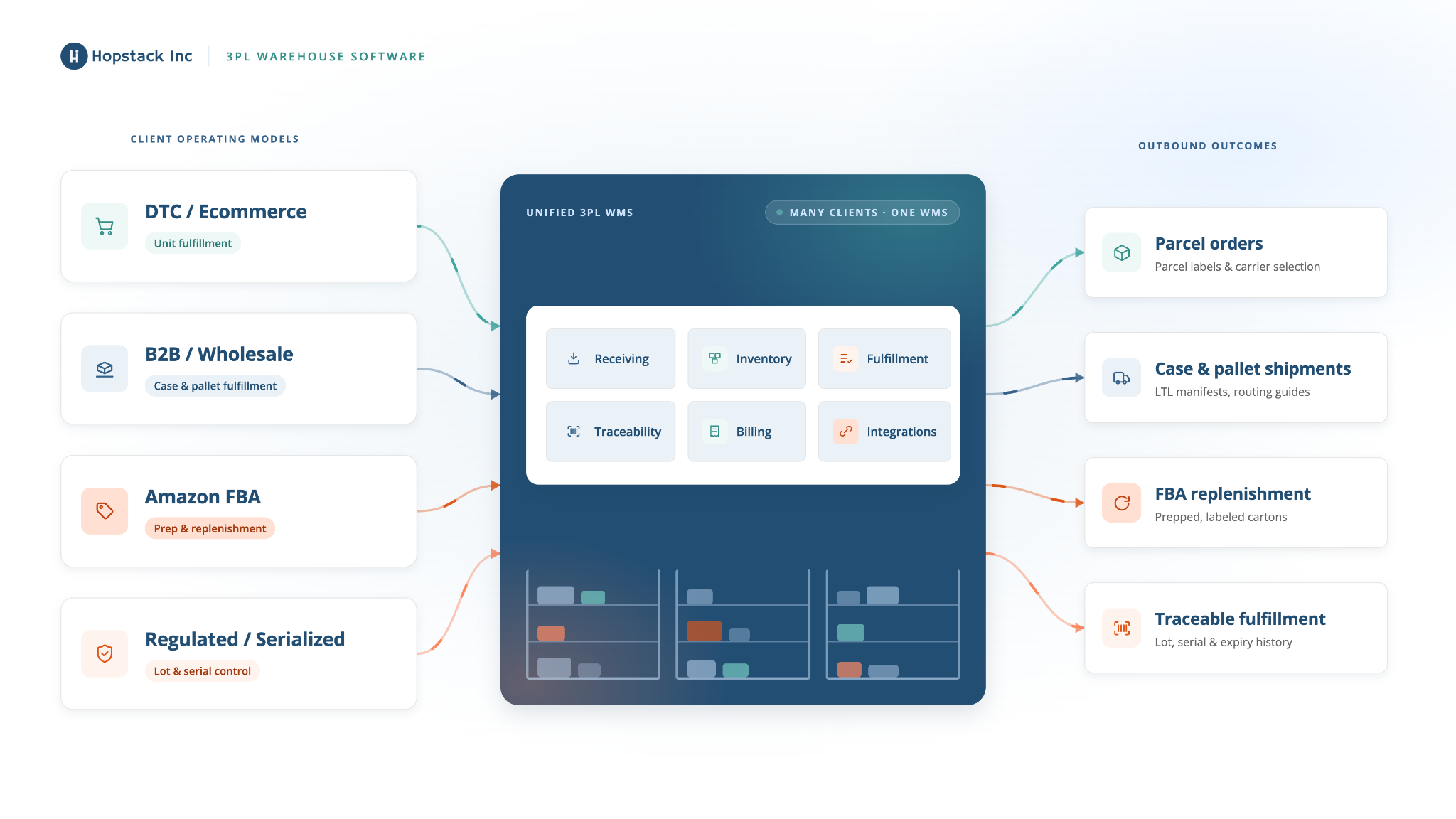
A 3PL does not run one fulfillment operation. It runs several client operations through the same warehouse.
Take a 3PL handling a stationery brand. Inventory arrives in cases, but most orders leave as individual notebooks and art supplies sold through Shopify. The warehouse needs to receive those cases, keep an accurate count of the units inside them, and fulfill the brand's daily orders.
Now the same 3PL onboards a consumer electronics client that needs serial-number tracking. Later, a food brand comes in with products that have different expiry dates. The warehouse has not changed, but the receiving, inventory, and fulfillment requirements have.
That is what 3PL warehouse management software has to accommodate: different clients, different product categories, and different ways of fulfilling orders within the same operation.
At Hopstack, these are the conversations we have with 3PLs during discovery and implementation. The starting point is usually quite practical. What inventory will arrive? What needs to be captured when it does? Where will the orders come from, and how will the team process them?
The answers determine the depth required from the warehouse management system, or WMS. The following seven capabilities cover what a 3PL needs to manage that work, from onboarding a client and receiving its first shipment to handling higher volumes and billing for the services performed.
1. Multi-client management and client-specific configuration
A 3PL needs one WMS to serve many clients without flattening them into one operating model. That starts with physical and logical separation. Two clients may stock the same physical product under different SKU codes, but their inventory, locations, containers, permissions, and transactions still need to remain distinct. Within a single client, the opposite can also happen: the same physical item may appear under different channel-specific SKUs on Shopify, Amazon, or another marketplace while drawing from the same inventory pool.
The more important capability is configuration at the right level. Some rules belong to the 3PL tenant, while others need to apply by client, warehouse, product, or workflow. One client may require branded inserts, another serial capture, another FEFO allocation, and another its own carrier account. Those policies should appear in the actual receiving, picking, packing, and shipping flow rather than live as notes that operators need to remember.
Client access follows the same principle. Each customer should see its own inventory and orders, with the actions the 3PL allows, while other clients' data and the 3PL's internal commercial information remain private.
The test is simple: adding a new client should mean configuring its operating model inside the WMS, not creating another parallel process around it.
2. Deep inventory traceability and control
For a 3PL, inventory traceability begins at receiving and has to survive every movement that follows.
The WMS should capture what was expected, what actually arrived, and the attributes that matter for that product. A short receipt, damage, or a consignment received over more than one day should remain visible without forcing the warehouse to close the entire inbound movement.
It also needs to understand handling units and their relationship to individual pieces. Take a skincare brand receiving ten cases with 24 units per case. The warehouse has 240 units, but it may ship one unopened case to a wholesale customer and individual units against ecommerce orders. The WMS should preserve both the case and unit relationship as cartons are opened, moved, and picked.
The traceability requirement then changes by product category. Consumer electronics may require serial capture so the warehouse can identify which device shipped on which order. Medical devices may require both lot and serial tracking. Frozen or perishable goods may depend on lot, expiry, FEFO allocation, and minimum remaining shelf life. Pharmaceutical workflows may add batch tracking and inventory statuses that prevent stock from being allocated until it is released.
The important point is not whether the WMS has fields called lot, serial, or expiry. Those attributes need to influence allocation, picking, verification, replenishment, returns, and inventory adjustments.
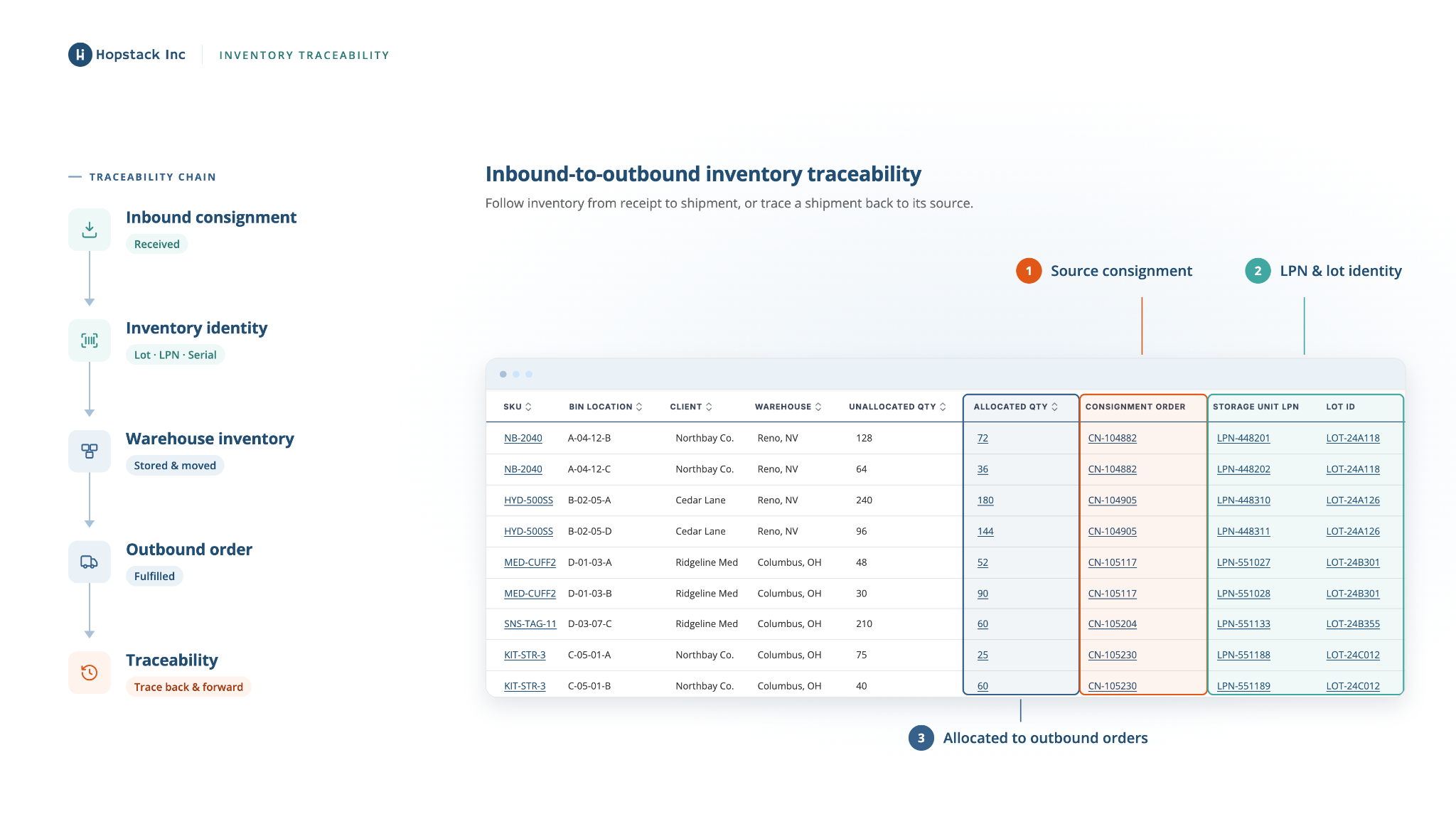
This becomes particularly valuable during a recall or shipment investigation. The warehouse should be able to start with a lot or serial and identify the inventory still on hand and the outbound orders it reached. It should also be able to start with an outbound order and trace the shipped inventory back to the inbound consignment from which it was received.
Hopstack's consignment linkage keeps that inbound-to-outbound relationship intact, alongside the relevant lot and LPN details. That gives a 3PL a usable traceability trail instead of forcing the team to reconstruct it across separate records.
.png)
3. Fulfillment workflow orchestration
A 3PL WMS needs enough dexterity to run different fulfillment models in the same warehouse.
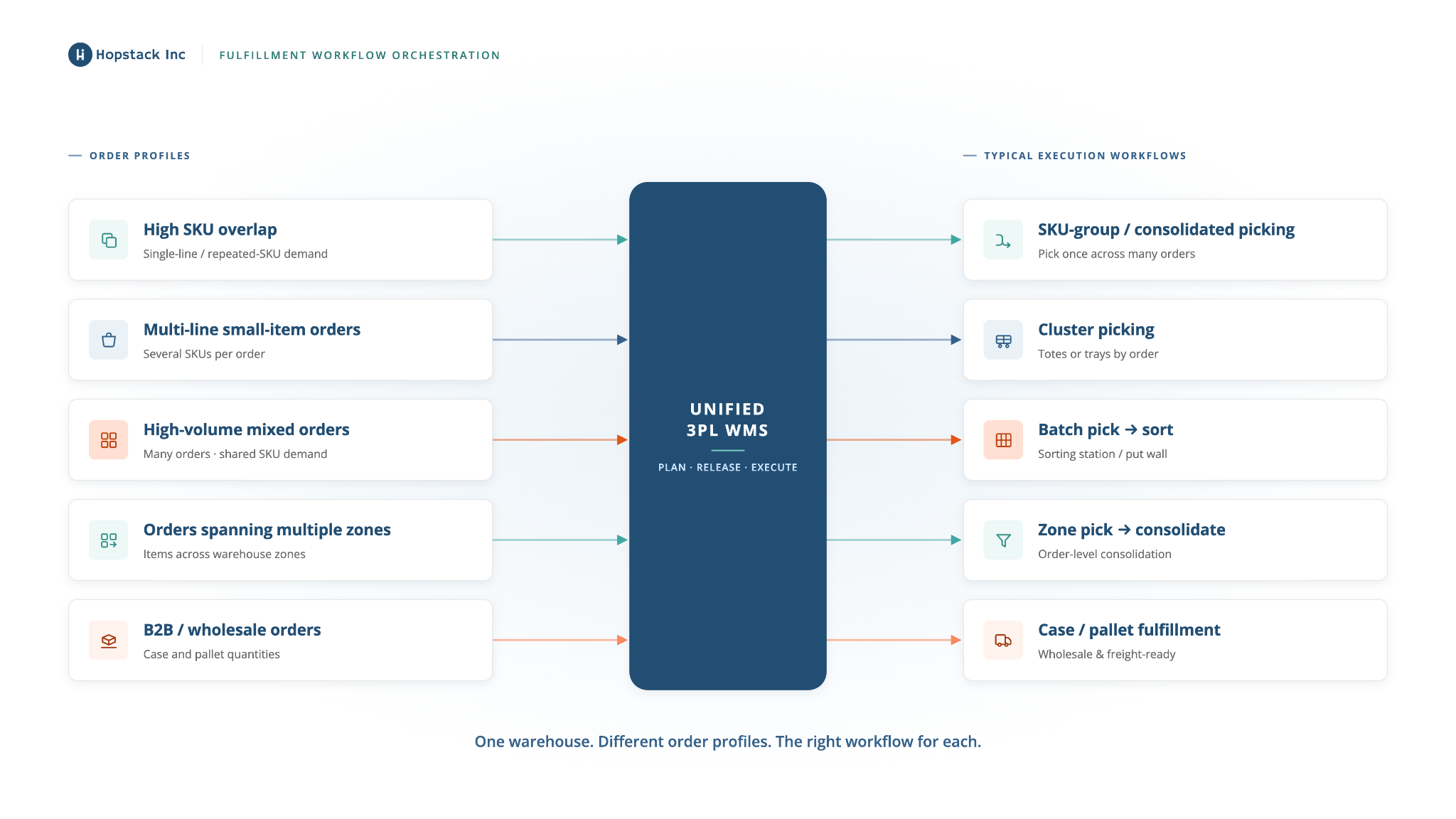
The starting point is the order profile: single-line versus multi-line orders, SKU overlap across orders, item size, case or pallet handling, warehouse layout, and shipping cutoffs. A large run of single-item DTC orders should not be forced through the same workflow as multi-line jewelry orders, wholesale case picks, or pallet shipments.
The system should therefore support different execution strategies such as consolidated or SKU-group picking, cluster picking with sub-totes or trays, batch picking followed by sorting at a put wall, and zone picking with order-level consolidation. The goal is not to choose one "best" strategy, but to let the warehouse apply the right workflow to each order profile while preserving order identity and priority through the handoffs.
Kits and bundles add another layer. A physical bundle can be assembled in advance and held as finished inventory. A virtual bundle may exist only as a sellable SKU, with its components picked and combined when the order is fulfilled. The WMS needs to understand both models so component inventory is deducted correctly and the warehouse knows whether it is picking a finished kit or building one during fulfillment.
Exceptions also need a controlled path. If one line is short, completed picks should remain completed while the remaining quantity is redirected, held, or partially fulfilled where the client and channel allow it. The system should preserve the history rather than make the team recreate the order.
This is where orchestration matters: planning, picking, consolidation, packing, and exceptions need to operate as one connected fulfillment flow.
4. Order channel and shipping integrations
A 3PL may need to connect to very different client and transportation ecosystems, so integration depth matters as much as integration breadth.
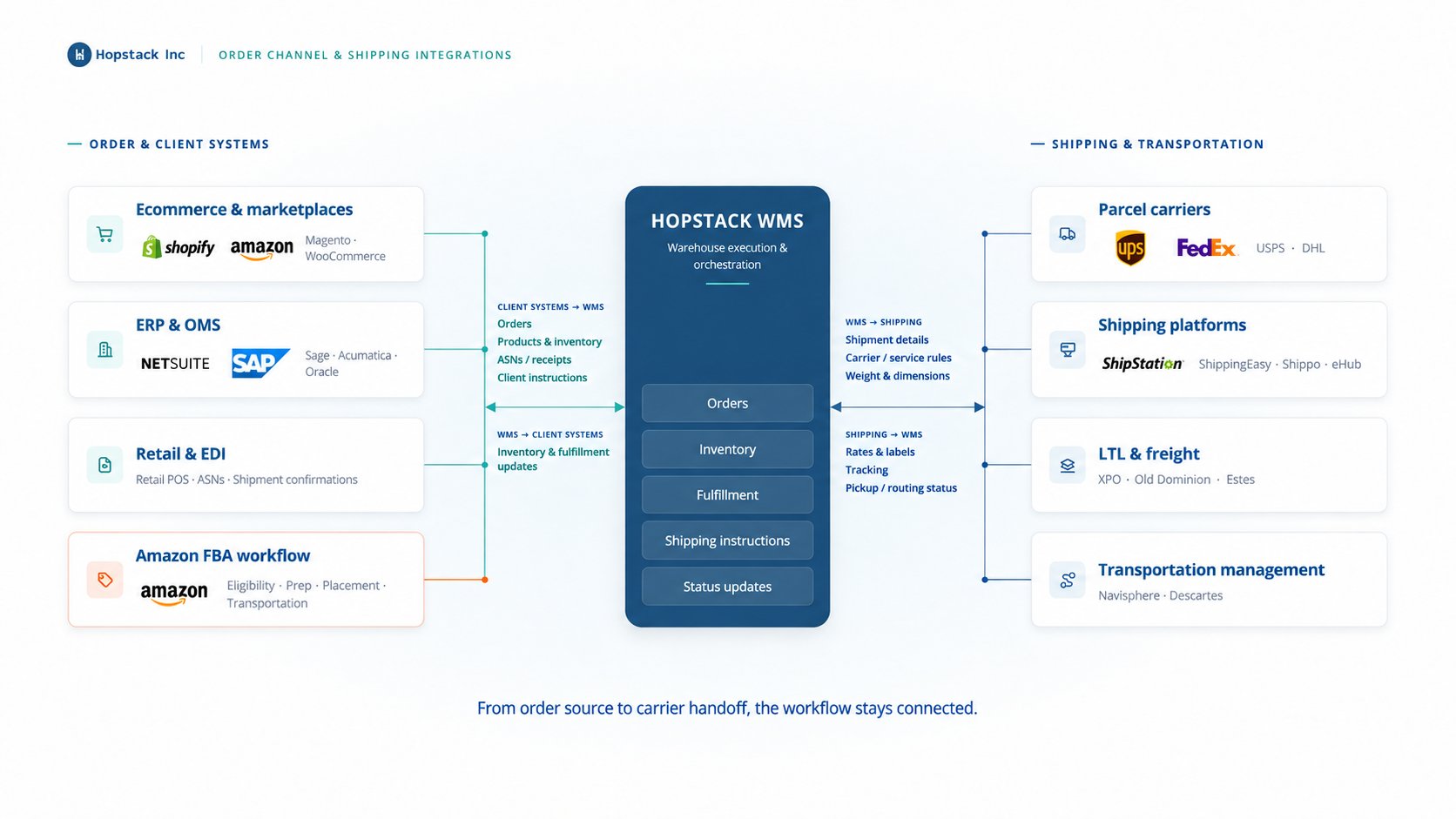
On the order side, a client may sell through Shopify, Magento, or WooCommerce, run its business on NetSuite, Sage, Acumatica, SAP, or Oracle, or send retail orders through EDI when it starts supplying big-box retailers. The WMS needs to support the appropriate order, product, inventory, ASN, shipment-confirmation, and status flows for that client rather than assume that one connector covers every workflow.
Amazon FBA is a good example of why depth matters. Reading Amazon inventory and creating a manual replenishment order is only a small part of the process. A deeper FBA integration can keep eligibility checks, packing requirements, placement decisions, box details, labels, and transportation selection within the WMS so a 3PL does not have to keep jumping into each client's Seller Central account.
Shipping integrations have a different job. Some orders arrive with a carrier and service already determined by the client's OMS or routing instructions. Others need parcel or LTL rate shopping. The WMS may connect directly to carriers such as UPS or FedEx, through shipping platforms such as ShipStation, ShippingEasy, Shippo, or eHub, or to LTL carriers and TMS platforms for freight planning and scheduling.
For larger freight moves, the WMS should pass the shipment, pallet, weight, dimension, and readiness data a TMS needs, then bring back the relevant routing, pickup, and status information. The WMS does not need to become the TMS, but the handoff has to be operationally clean.
Across all of these connections, failures need to be visible and recoverable. A retry should not create a second order, repurchase a label, or repeat an inventory adjustment.
.png)
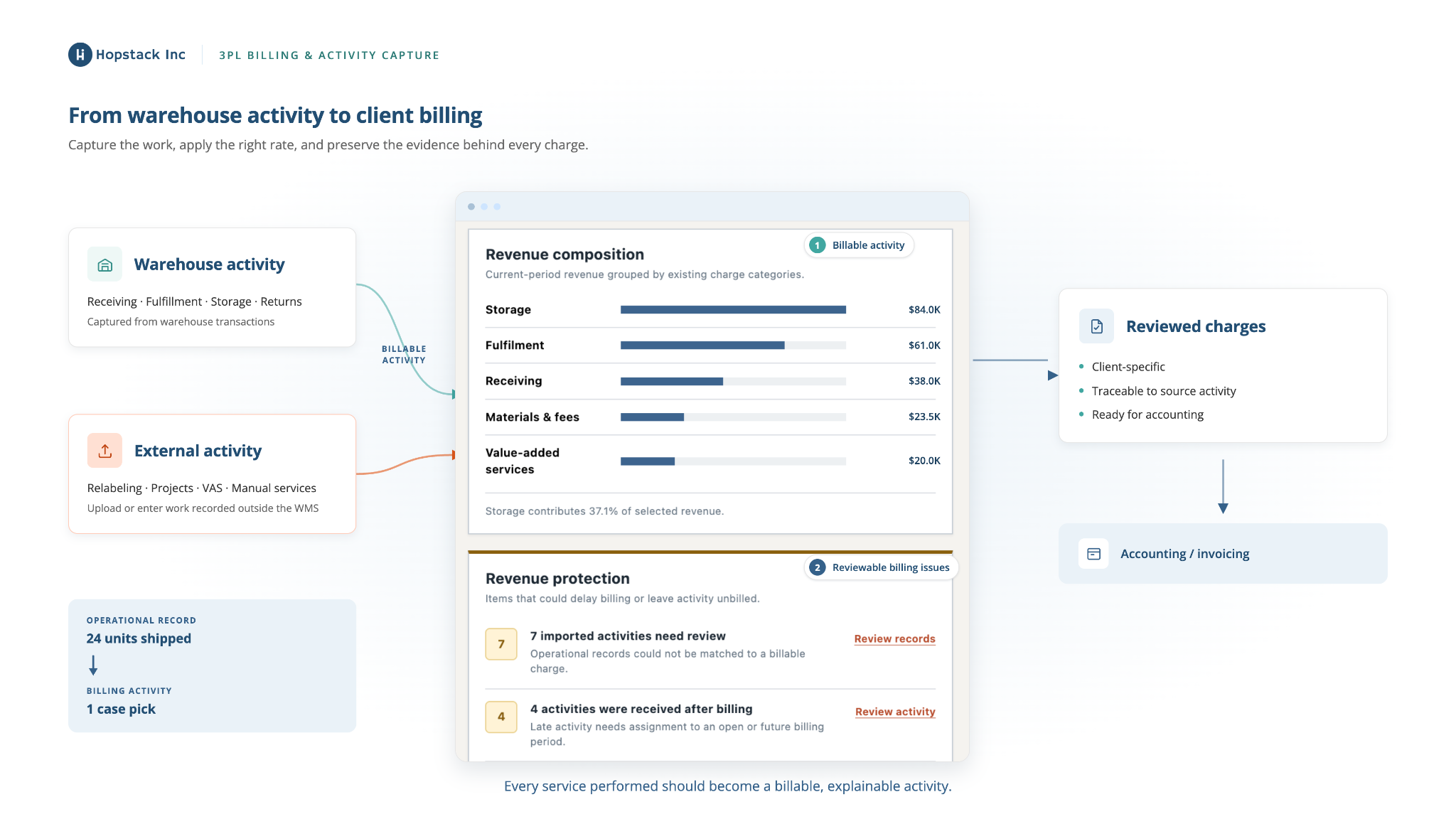
5. 3PL billing and activity capture
Billing is a core 3PL capability because warehouse activity is also the basis of revenue.
The system needs client-specific rate cards that can apply the right charge to the actual activity. Receiving might be billed by pallet or unit, fulfillment by order, line, case, or piece, and storage by pallet position, occupied space, or a minimum commitment. If an associate ships one unopened case of 24 units, the inventory movement may be 24 units while the billable activity is one case pick. Both records need to remain correct.
The billing layer also has to cover work that does not originate inside a standard WMS transaction. A 3PL may perform relabeling, special projects, disposal, inspections, or other value-added services captured in a spreadsheet or another system. The billing workflow should allow that activity to be uploaded or entered with the client, service, quantity or hours, and supporting reference, then pass through the same rate application and review process as WMS-generated work.
Charges should remain traceable to their source, and billing frequency should follow the client arrangement rather than force every activity into the same cycle. Once approved, the charges can move to the accounting system for invoicing and payment.
The objective is straightforward: all work performed for a client should be billable and explainable, whether it originated in the WMS or elsewhere.
6. Client portals and visibility
Visibility has two audiences: the warehouse team running the operation and the client whose inventory is being managed.
For supervisors, the system should surface work that needs attention rather than only aggregate counts. A blocked-order number is useful only if the team can open it and see which orders are waiting for stock, address correction, a label, or another action. Inbound views should similarly show what is expected, received, put away, and how long work has been waiting at each stage.
Client portals need a different level of access. A client should be able to see its inventory by warehouse, available versus committed stock, inbound progress, and outbound order status without asking the 3PL for a spreadsheet each time. Where the operating model allows it, clients can also submit expected receipts or orders directly.
Reports then provide the longer-term operating view, such as throughput, inventory discrepancies, and turnaround by client or workflow. The value is not the number of dashboards. It is giving each user a consistent, permission-appropriate view of the same underlying warehouse activity.
7. Multi-warehouse operations and scale
A 3PL WMS has to scale in two directions: more volume and more operating complexity.
We have seen 3PLs move from spreadsheets, or from ShipStation stitched together with other fulfillment tools, into a WMS as their client base grows. A platform that works when a client ships 100 orders a month should still work when that same client reaches 10,000 or 20,000 orders. At that point, bulk order processing, batch planning, concurrent scanning, background label generation, and visible exception handling become operational requirements rather than conveniences.
Multi-warehouse operations add another dimension. Inventory should remain clear by facility while still giving the 3PL and its client a connected view. Orders may need to be routed to the appropriate warehouse based on inventory, client rules, geography, or service requirements. Transfers should connect the source warehouse's dispatch to the destination warehouse's receipt without making in-transit stock appear available in both places.
Scale is not only about order count. A new medical-device client may introduce serial traceability, while a wholesale client may introduce case picking, EDI, or an ERP integration before it adds much volume. The WMS needs to absorb those new workflows without forcing another core-system migration.
Implementation still matters, but it should be practical: test the real products, scanners, printers, integrations, and critical workflows before go-live, with a clear path for support when fulfillment is blocked.
Actively comparing platforms? Read: Best WMS Software for 3PLs in 2026 | Compare, Evaluate & Scale
The software has to support the full operation
A 3PL WMS has to do more than keep inventory counts and print labels. It has to preserve the operating differences between clients while connecting receiving, traceability, fulfillment, integrations, visibility, billing, and scale.
That is what allows a 3PL to add clients without adding a separate manual process for each one, and to keep serving those clients as their requirements and volumes grow.
At Hopstack, we start with the actual warehouse workflow and configure the platform around the way the operation needs to run.
.png)
FAQs
What is the difference between a general WMS and 3PL warehouse software?
A general WMS manages inventory and fulfillment for one operation. A 3PL WMS has to do that across multiple clients, with separate ownership, client-level rules, integrations, access, and billing.
Which capabilities should a smaller 3PL prioritize?
Start with the workflows its clients already require: accurate receiving and inventory, order execution, essential integrations, client visibility, and billable activity. The platform should then be able to add more traceability, automation, and scale without forcing a system change.
How should a 3PL WMS handle different client workflows?
Rules should be configurable at the tenant, client, warehouse, product, or workflow level. That lets one client use FEFO allocation, another serial capture, and another its own carrier account while the 3PL still runs one common platform.
What integrations matter most for a 3PL WMS?
That depends on the client mix. Common requirements include ecommerce channels, ERPs, EDI for retail trading partners, parcel carriers and shipping software, Amazon FBA workflows, and LTL or TMS connections.
Can a 3PL WMS support both DTC and B2B fulfillment?
It should. DTC may require high-volume unit picking and parcel shipping, while B2B may require cases, pallets, routing instructions, LTL, and EDI. The WMS needs to support both without forcing them into the same execution flow.
Does a 3PL WMS replace an ERP or accounting system?
Not necessarily. The WMS manages warehouse execution and inventory. A client's ERP may continue to manage commercial records, while the 3PL's accounting system handles invoicing and payments. The important requirement is clean data exchange between them.
.png)

